AI has earned its place in most enterprises. Employees are drafting, analyzing, and shipping work faster than they were a year ago, and some workflows have been rebuilt around the tools. When the cost of that use calls for governance, the task is to apply it without eroding what makes AI worth having: how much it gets used, and the momentum and confidence people have built with the tools.
Most teams are arriving here for the first time. The company encouraged adoption, adoption grew, and as it grew so did the cost of running it. At some point trials end and the real constraints surface, whether that's capability costs, usage budgets, or a slowdown in the momentum teams have built with the tools. How the company responds either reinforces its AI strategy and the adoption momentum behind it, or creates new headwinds for both.
Why Constraints Are Inevitable, for Now
A company has two options with AI: hold back and watch competitors pull ahead on the same work, or adopt and take on the capability and the cost together. Almost everyone has chosen the second. Once AI is widely adopted and in real use, its cost becomes a real line item, and real line items get governed.
The cost side is the easy part to explain. Compute is supply-constrained relative to demand right now, and the gap is not closing soon. Jensen Huang at NVIDIA called the current AI buildout "the largest infrastructure buildout in human history" and put a marker on its scale: the industry is "a few hundred billion dollars into it," he wrote, with "trillions of dollars" of it still to come.
The framing comes from a chip vendor that profits directly when AI demand grows, but it converges with what vendor pricing decisions are showing. In March 2026, Anthropic introduced peak-hour throttling on paid Claude subscriptions affecting roughly 7% of users. Even the vendor sitting closest to its own cost structure has to ration during high-load windows.
Inside enterprises, the equivalent constraint shows up one layer further removed. Most companies do not see compute capacity directly; they see vendor invoices and per-user tier structures. As consumption per employee climbs, those invoices climb with it. OpenAI's State of Enterprise AI 2025 report puts the recent slope on record: weekly Enterprise messages grew roughly 8x year-over-year since November 2024, and reasoning token consumption per organization increased about 320x in 12 months. The same vendor that sold the enterprise AI seat a year ago is now serving an employee who uses 8x more messages and far more reasoning tokens, often on the same per-seat price.
8x
Weekly enterprise AI message volume, year-over-year growth
~9x
ChatGPT Enterprise seat count, year-over-year growth
~320x
Reasoning-token consumption per organization, 12-month growth
OpenAI, State of Enterprise AI 2025 Report.
The cost shock from that climb is now showing up at named companies. Axios reported in late May 2026 that one enterprise spent half a billion dollars on Claude in a single month after failing to set per-employee usage limits, and Microsoft has since canceled most of its Claude Code licenses partly over cost. The "tokenmaxxing" reflex, push as many tokens through the tool as the budget allows, is correcting in real time.
That is the underlying math behind every cap-rollout email. The response to it is where the discretion sits. Employees can be told ahead of time, or after the fact. They can be given a usage dashboard, or asked to estimate. They can be given guidance on what to do differently, or left to figure it out. The cost curve is mostly outside any one company's control. The communication around it is entirely inside it.
None of this is permanent. The pressure behind these constraints comes from compute being scarce relative to demand and from usage being less efficient than it will be, and both are moving. Capacity is being built out, and models and habits are getting cheaper per unit of work. The constraint is real now and worth managing well now, but it is a feature of the short term, not a fixed condition.
Which Usage Is Worth Protecting
Pressure to cut arrives, whatever form it takes. The easy response is to trim across the board: everyone trims a little, the heaviest users trim the most. But AI usage is not uniform. Some of it is doing work that matters, and some of it is reflex. Handling that pressure well, on either side, means protecting the first kind and trimming the second, which makes the prior question unavoidable: which is which.
High-value usage
- Tied to a real outcome someone would notice if it stopped
- Would take materially longer, or not happen at all, without AI
- Resists substitution by a cheaper mode or a non-AI path
Low-value usage
- Designing solutions before setting clear goals or understanding who the work is for, so the output looks finished but is not aimed at anything
- Leaving the model selector on "Pro" or "Thinking" by default, burning capacity on tasks a fast model would finish identically
- Reaching for AI on problems where one exact answer is needed every time (calculations, lookups, formatting) when a script or calculator would do it more reliably
That distinction is what makes any of those constraints survivable. For an employee it separates protecting the work that matters from rationing blindly. For a leader it separates a constraint that trims slack from one that cuts into the adoption gains the company paid for. The guidance that follows, on both sides, assumes that sorting has been done first.
For Employees: Keeping Your Pace When Limits Land
The goal under a cap is unchanged: the same output from AI, on a tighter budget. The cap changes how, not whether. With the high-value usage identified, the employee's task is to protect it while trimming the rest, and that is a real decision, the kind worth making deliberately. The guidelines below cover most of the useful moves, roughly in the order worth working through them.
Understand and choose
-
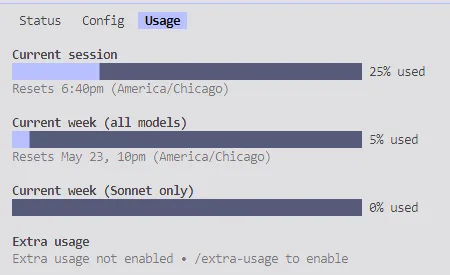
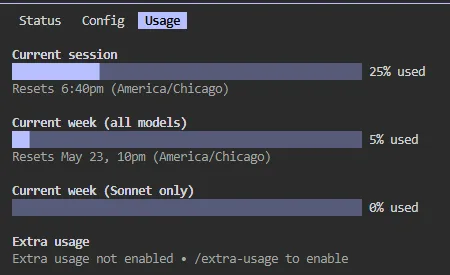
Claude Code's /usage panel, in the terminal
Assess what the cap actually counts. Start with the unit. Some plans meter tokens directly, the raw units a model reads and writes; others meter "credits," which are essentially tokens repackaged into a simpler number, often a flat charge set by a message's model and mode rather than its length. A deep-reasoning query on the most capable model can cost 50 to 100 times more than a fast-response query on a smaller one, while a short prompt and a long one on the same model may cost the same. Knowing which unit applies decides which of the moves below actually help; until that is clear, optimization is guessing. Read whatever documentation the vendor publishes, and find the usage surface if the tool exposes one.
Coverage is uneven. Claude Code's /usage command reports consumption against limits with guidance tied to a user's own history; because Claude Code is a command-line tool, that surface lives in the terminal rather than a web dashboard. ChatGPT, as of mid-2026, surfaces credit usage and downloadable reports only to workspace owners (find them under Workspace settings > Billing), not to the individual hitting the cap. Unless a company has built its own usage dashboard, an Enterprise ChatGPT user who is not a workspace owner has little direct read on their own consumption. The workable substitute is attention rather than bookkeeping: take a mental note of what the major efforts cost, watch how usage moves across a cycle, and let that growing sense of personal consumption inform which of the tactics below are worth pursuing.
- Match the mode to the task. AI tools meter by what gets used, and the spread is wide. On ChatGPT's enterprise rate card, the fast model runs unlimited at no credit cost, while a Thinking message costs around 10 credits and a Pro message around 50; features bill on their own, an agent-mode message about 30 credits and a deep-research task about 50. The figures are ChatGPT's, but the shape holds across vendors: a metered budget with a wide gap between a cheap default and the expensive modes. The practical move is to keep the free model as the default and spend credits deliberately, reserving the heavy models and features for the work that genuinely needs them. The discipline is choosing consciously rather than letting the interface default to the most-capable option for every query.
Models
Credits per message
InstantFreeThinking10Pro50Core features
Credits, by unit
Image creation5 / imageVoice5 / minAgent mode30 / msgDeep research50 / taskFrom OpenAI's enterprise rate card, mid-2026. Chat models and core features bill a flat rate per message or per use; the same vendor prices its automated agent, spreadsheet, and coding tools (Codex) by the token instead, where a typical developer runs roughly $100 to $200 of usage a month.
- Reserve the heavy tools for proven work. A tier above the expensive modes is the autonomous tools: Codex, Claude Code, Claude Cowork. They run for minutes or hours, consume tokens at orders of magnitude above a single message, and produce material work in return. The right fit is workflows that have been scoped and have track record; the wrong fit is exploratory tasks where a cheaper mode is enough. The cost gap between right-fit and wrong-fit use is large enough that they belong in their own category, not as richer versions of the chat model.
Work leaner
- Reduce wasted requests. A real share of cap consumption is rework: re-asking something already answered, or sending a vague prompt that takes three tries to land. A few habits trim it. Batch related questions into one well-formed request instead of a string of small ones. Spend a moment on prompt clarity up front, since a clear first ask costs less than several muddled ones (the GCSE framework is a useful starting point). Search past conversations before regenerating an answer that already exists. And for work returned to repeatedly, a Project keeps the shared context in one place, which the tool can cache rather than reprocessing on every query.
- Do not push critical work into low-supply windows. If remaining usage is thin and something fails, triage gets harder, not easier. Solid drafts, queued asks, and end-of-cycle smoke checks all reduce that risk. The work that has to be right by Friday should not be the work that runs first on Friday afternoon with the cap nearly hit. Treat the back half of any cycle as a tighter operating envelope and plan accordingly.
- Be deliberate about formats. Markdown and plain text are cheap to process; PDFs, images, and long file attachments are expensive. How much that shows up in the bill depends on the meter: where usage is metered by token, lean inputs cut cost directly, and where it is metered by flat per-message credits, a single message's price holds regardless, though heavy inputs still cost speed and context room. The tokens underneath are real either way, and long contexts compounded across many queries drain a token budget the same way one heavy session can, often invisibly until the number lands at the end of the cycle. Compressing inputs before invoking keeps headroom for the harder problems later in the month.
Lean inputs, cheap to process
- Markdown and plain text
- Structured data (CSV, JSON)
- Trimmed, relevant context
Heavy inputs, expensive to process
- PDFs and scanned documents
- Uploaded images and screenshots
- Large or unfiltered attachments
Get more room when you need it
- Reach for an alternative. A cap on one vendor does not cap AI itself. Most enterprises license more than one tool, so a capped ChatGPT user often still has Microsoft Copilot available. And for work that doesn't touch sensitive data, free options like Google's AI Mode in Search or Claude's free tier are one tab away. Moving routine work to another surface keeps things moving while the primary tool's budget resets. The move is to know which alternatives fit which kinds of work before the cap is hit, and to keep sensitive material on whichever tool is sanctioned for it.
- Consider procurement, where policy allows. If the constraint is real and the work depends on it, the answer is not always efficiency. It is sometimes additional access. Some enterprises permit personal subscriptions on personal devices for work-adjacent learning and drafting. Some have approval paths for additional seats, higher tiers, or vendor extra-usage options. Each requires visibility from the employee toward the right approver, which is a conversation that goes better with a clear sense of the usage behind the request than without one.
For Leaders: Constraining Cost Without Stalling Adoption
For a leader, the goal is to control cost without giving back the adoption the company spent a year building. A handful of aims keep that on track.
There is more room to move here, because the gap is sequencing, not budget. The sequence: a year of encouragement through memos, town halls, and feature rollouts, then a one-time email tightening the envelope when the bill catches up. That asymmetry is where most of the friction sits.
What to aim for
- Keep momentum high
- Lead with clarity
- Avoid unintended surprises
- Enable options and exceptions
Those are the aims. The moves below are how leaders can meet them.
Set expectations early
- Share the vision for where consumption is going. Constraints land worst when they look like the only direction the organization has thought about. Better is to share the broader consumption story openly: features being evaluated for rollout (agents, deep-reasoning modes, coding tools), what each one tends to do to per-seat consumption, and how the company expects to absorb that. Each new capability the company ships shifts the consumption baseline. Treating that as a known input rather than a surprise correction changes the conversation. The consumption story has a vendor side too: peak-hour throttling and OpenAI's recent "Guaranteed Capacity" reserved-compute contracts are early signals of where access pricing is headed. Introductory "unlimited" allowances are the near-term trap: enticing now, but the bill resets when the promo ends, so flag it before teams build habits around capacity that will not last.
Today
Where AI is delivering value now. The workflows and roles already changed by the tools in place.
Short term
What the company is building toward next. The initiatives being scoped and the capabilities being tested.
Long-term target
The organizational goal AI is meant to serve. The work the company wants AI embedded in.
- State the cost model up front, not after. When AI tools first roll out, the natural messaging is about capability. That work is necessary. It is not sufficient. The same rollout deck that explains what the tool does should explain what it costs and how that cost gets divided. Employees are calibrated enough now to absorb both at once. They are not calibrated to receive cost information a year after they were encouraged to use the tool freely.
Support people doing the work
-
Provide self-monitoring surfaces. A reasonable bar is Anthropic's personal Claude usage UI, which shows users their consumption against their cap in close to real time. Enterprise plans rarely surface this by default. If the vendor does not provide it, build a thin internal one. The point is not perfect precision; it is reducing the share of employees who hit a cap by surprise rather than seeing it coming.
And when the surface does exist, it has to reach employees with the cap announcement, not a day later. The most common failure here is a coordination slip, the dashboard and the email going out separately, rather than a missing tool or a missing plan.
-
Back the people pulling ahead. Some of the early intensity was the novelty of a capable new tool, and as that wears off a share of usage settles or cools on its own. That is the curve finding its real level, not a failure. The case worth watching is the opposite one: the people who have quietly rebuilt how they work around AI and produce materially more for it.
A cost constraint is a good moment to find them, since their usage stands out against the settling average, and to make sure the constraint does not fall on the work that is genuinely transforming. Resourcing the people leading that shift beats spreading the budget evenly. In practice that often means higher tier allotments and access to the heavier token-billed tools (agents, coding assistants like Codex, deep research) for the people who can put them to genuinely transformational use.
-
Provision the heavy tools deliberately, not by default. A seat with the agentic tools enabled can consume orders of magnitude more than a chat seat, and because they bill by the token, the cost climbs with use instead of sitting at a fixed monthly price. Granting them to everyone puts that open-ended cost on the whole org when only part of it needs the capability.
The better default is to enable agentic access by demonstrated capability and real need, then widen it as the work justifies it. Deciding who gets the expensive tools is a separate lever from capping how much any one person can spend, and using both keeps one unrestricted seat from running up the bill that forces a correction later.
Baseline · every seat
A general AI seat with the standard models, fast responses and the thinking modes alike, for drafting, analysis, and everyday work. Available to everyone from day one.
IncludesExpanded · by capability
The agentic toolset, Codex, Claude Code, agent mode, and deep research, opened once a short evaluation confirms capable use, within set usage budgets. By capability, not job title.
IncludesFull · by capability + need
Higher budgets, third-party and bespoke systems, and custom frameworks, for the specific workflows whose output justifies the spend. Granted where capability and real need meet.
Includes - Publish guidance, not just policy. A cap email that announces tiers without also explaining how to operate inside them sends every employee off to learn the same lessons in parallel. Centralized tips on how the plan meters usage (by token or by credit), model selection, format efficiency, and when to use deep reasoning save the same individual decisions from being relearned across the organization. Published guidance also surfaces the cases where the cap is genuinely insufficient and a different tier or alternative tool would be the right answer.
- Roll cost context through the same channels that ran adoption. Communities of practice, manager forums, leadership briefings. The same surfaces that pushed "use the tool more" are the natural place to brief the new tier structure and the operating habits that go with it. One-time email rollouts of cost discipline land badly because they do not get the discussion that adoption rollouts got. The medium is part of the message.
-
Give people more than one tool, with shared guidance on what fits where. A constraint on a single vendor is a hard wall. Most enterprises already run more than one AI tool, Microsoft Copilot alongside ChatGPT or Claude, and broadly available options like Google's AI Mode sit one tab away for anyone with a Google account. Routing routine work to whatever is uncapped or cheapest for the task turns a single vendor's constraint into a detour rather than a wall, and reduces the single-tool dependency that makes any one constraint painful.
The catch is silos: without shared guidance on which tool fits which kind of work, multiple tools become fragmented islands of context and effort. Publishing that fit-for-purpose guidance alongside the access is what keeps the optionality from becoming fragmentation.
In practice, whether an announcement sustains adoption momentum or stalls it comes down to what travels alongside it.
What the announcement says
- Usage figure
- New tier structure
- Effective date
What to send alongside it
- The cost and tiering rationale, in plain terms
- A link to the usage dashboard
- Operating guidance for staying inside the tier
- A path to expand access, by capability and need
Shipping Ahead of the Operating Model
The misstep this piece traces, pushing AI adoption hard and then handling the constraints that follow as a one-time correction, sits inside a broader dynamic that shows up repeatedly in enterprise AI delivery. From observations across enterprise AI delivery and leadership conversations in 2026, the same sequencing keeps surfacing: build, integrate, go live, then think about the operating model that has to support what was built. Adoption gets celebrated on the launch slide and reconciled in the field weeks or months later.
Cost is usually the first place this shows up. Encourage adoption, ship features, then handle the constraint when the bill catches up. Governance is another version of it. Many policies and procedures were written for slower, higher-risk development, and applied to nimble AI work they ask questions that no longer fit and pile on enough overhead that following the procedure can take longer than building the solution it governs. That, too, discourages the adoption the company is trying to grow.
All of these are organizations pushing behavior change ahead of the support structure that makes the new behavior work. The fix is the same across them: move the operating-model conversation upstream so it lands at the start of the rollout, not as a correction halfway through. A longer-form read on this is the earlier piece on organizational structure as the enterprise AI scaling bottleneck.
Key Takeaway
AI earned its way into the enterprise by being useful, and that usefulness is still the point. A constraint on it is a constraint, not a verdict. The reflex when costs climb is to ration uniformly, and that treats AI usage as a utility to meter when it is really work the business chose to fund. Any other initiative competing for budget gets weighed on its alignment with business goals, the resources it needs, the leadership behind it, and its forecasted impact. AI usage deserves the same treatment: match access to demonstrated capability and need rather than spreading it evenly, resource the teams getting real value, question the usage that is not earning its cost, and keep any constraint from quietly shrinking what AI was brought in to do.
Further Reading & Sources
Further Reading
- The Operating-Model Bottleneck
How a company handles its first real AI constraint is one instance of a broader problem: organizations shipping AI faster than the operating model that supports it. The piece works through the structural fix.
Sources
- NVIDIA - Jensen Huang on the AI infrastructure buildout
- The Register - Anthropic tweaks Claude usage limits to manage capacity
- OpenAI - Guaranteed Capacity
- OpenAI - State of Enterprise AI 2025 Report
- OpenAI - ChatGPT credit rate card (Business, Enterprise, Edu)
- OpenAI - Codex rate card (token-based pricing)
- Axios - AI sticker shock hits corporate America